Write, then walk: Why a simple notes app is sufficient

Hi, it's Takuya. I want to share my thoughts and methodology on how to generate new ideas from your notes and memos.
I'm the author of Inkdrop, a Markdown note-taking app mainly designed for software developers with a core focus on simplicity. I might be a bit biased given my role, but I believe there is value in hearing the practical experience of someone who has spent nearly a decade developing a note-taking tool and exploring how ideas are actually born.
My conclusion is simple: You don't need an app to connect your notes for you. That is your brain's job. In this post, I’ll share how I stay focused on generating unique ideas without getting drowned in the complex note app features.
TL;DR
- Don’t waste time organizing notes; grouping is enough.
- Talented people wait for ideas to come to them
- The organic synergy of "Programming x Cooking."
- Write notes so you can forget
- Go for a walk!
Don’t waste time organizing; grouping is enough
Systems like Zettelkasten have become increasingly popular lately. For those unfamiliar, it’s an information management system developed by German sociologist Niklas Luhmann, where notes are interlinked to form a network. Many apps today are designed specifically around this "Second Brain" concept.
Luhmann reportedly used Zettelkasten to publish a staggering amount of high-quality books and academic papers. This suggests the method is incredibly powerful for scholars and researchers who need to systematize and reconstruct vast amounts of knowledge.
However, while Inkdrop supports backlinks, I have never made interconnecting information its primary focus. This is because, in daily software development and content creation, what we need isn’t a rigid taxonomy of knowledge — it’s flashes of insight and clues for problem-solving.
For developers and creators, complex network management can often become over-engineering. What matters more is the writing experience — the ability to frictionlessly jot down a bug you encountered, a random spark of an idea, or a snippet of information. For that purpose, a simple tree structure (folders/notebooks) is more than sufficient.
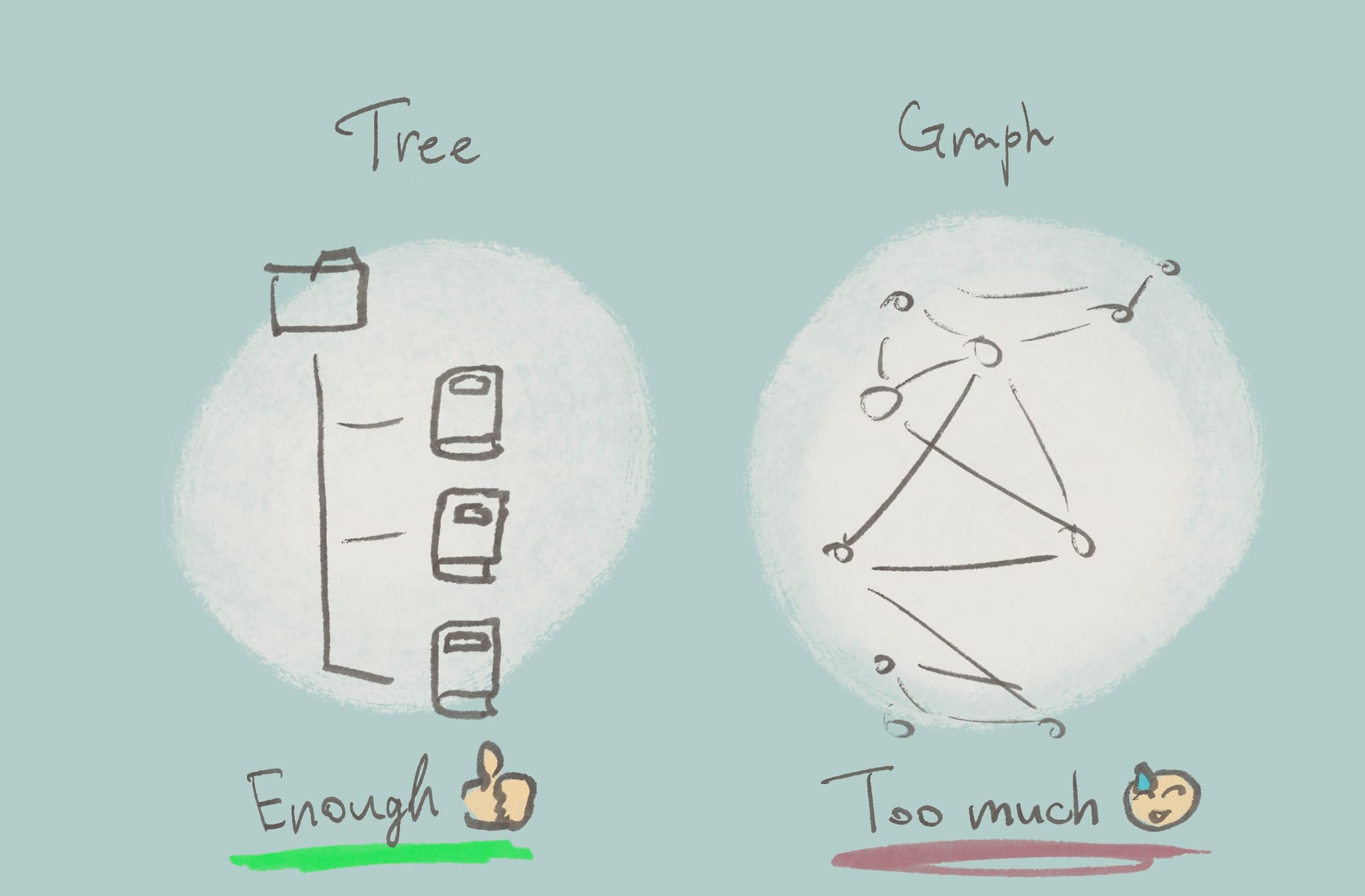
Note-taking apps are often lumped into one category, but it’s important to choose one with a concept that actually aligns with your specific goal.
Talented people wait for ideas to come to them
I remember back in grad school, my associate professor (now a full professor) dropped by the lab one day just to chat and said, "I’m just waiting for an idea to come to me." At the time, I thought, "Even someone this brilliant relies on such a vague, right-brained feeling?" But now, I understand exactly what he meant.
Staring at your notes at your desk only leads to a dead end. Answers derived through purely deductive logic often end up being "Captain Obvious" results—things anyone could have thought of.
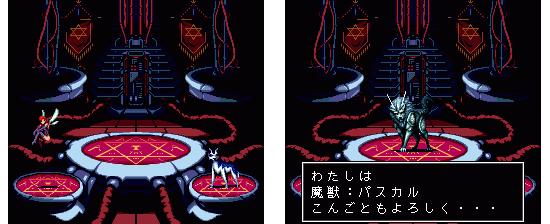
Interesting ideas and solutions that break through a brick wall come to you suddenly. You can’t force a breakthrough by fiddling with a note-taking app like you're performing a Shin Megami Tensei-style demon fusion.
The organic synergy of "Programming x Cooking"
As my app marketing, I upload videos to my YouTube channel, devaslife. For the first two years, things didn't really take off. But then, I posted the following video, and it quickly surpassed 1 million views:
This success eventually helped me grow the channel to over 200k subscribers. The key factor was applying the format of cooking videos to programming content.
Specifically, I brought the structure of a cooking video into the dev world:
- Show the finished dish first: Just as a plated meal piques your appetite, I show the final product first.
- Strip away unnecessary narration: You don't need a talkative host. Much like enjoying the sound of a knife on a cutting board, I let the typing sounds and the code speak to the viewer.
- Turning the "process" into entertainment: Instead of just showing the screen, I capture the scenery of development from various angles in the real world.
This seemingly eccentric combination would never have emerged from a logical network focused on systematizing information. Logic would suggest making "Tutorials on the latest frameworks" or "Engineering career advice"—things that everyone else is already doing.
Write notes to forget
How, then, do you use notes to generate unique ideas? My answer is: Scribble everything down. Below is a screenshot of my notes for YouTube ideas. As you can see, many have nothing but a title, or are unfinished ideas that never saw the light of day.
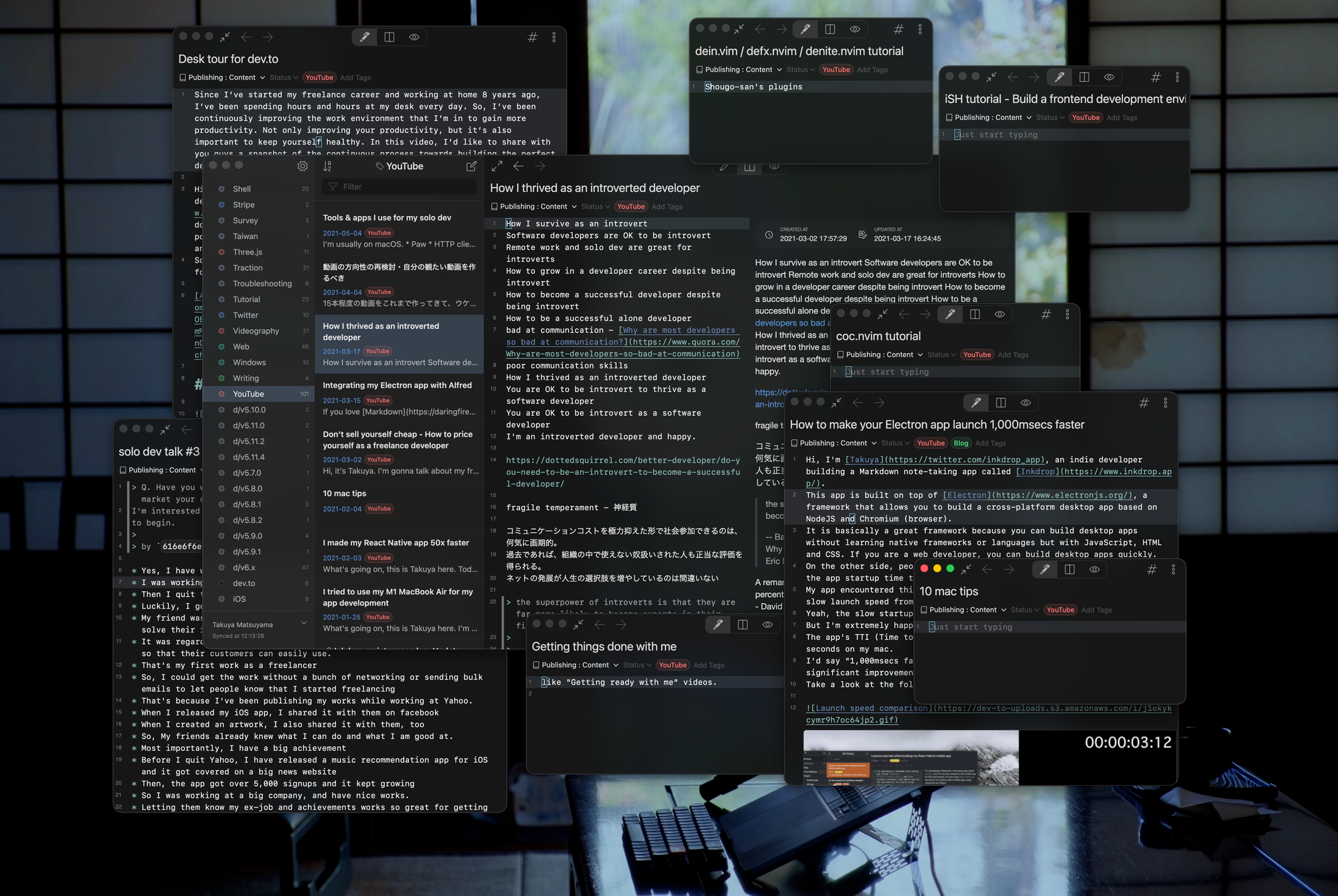
In a note-taking app, finishing a note isn't the point. There is inherent value in the act of writing itself.
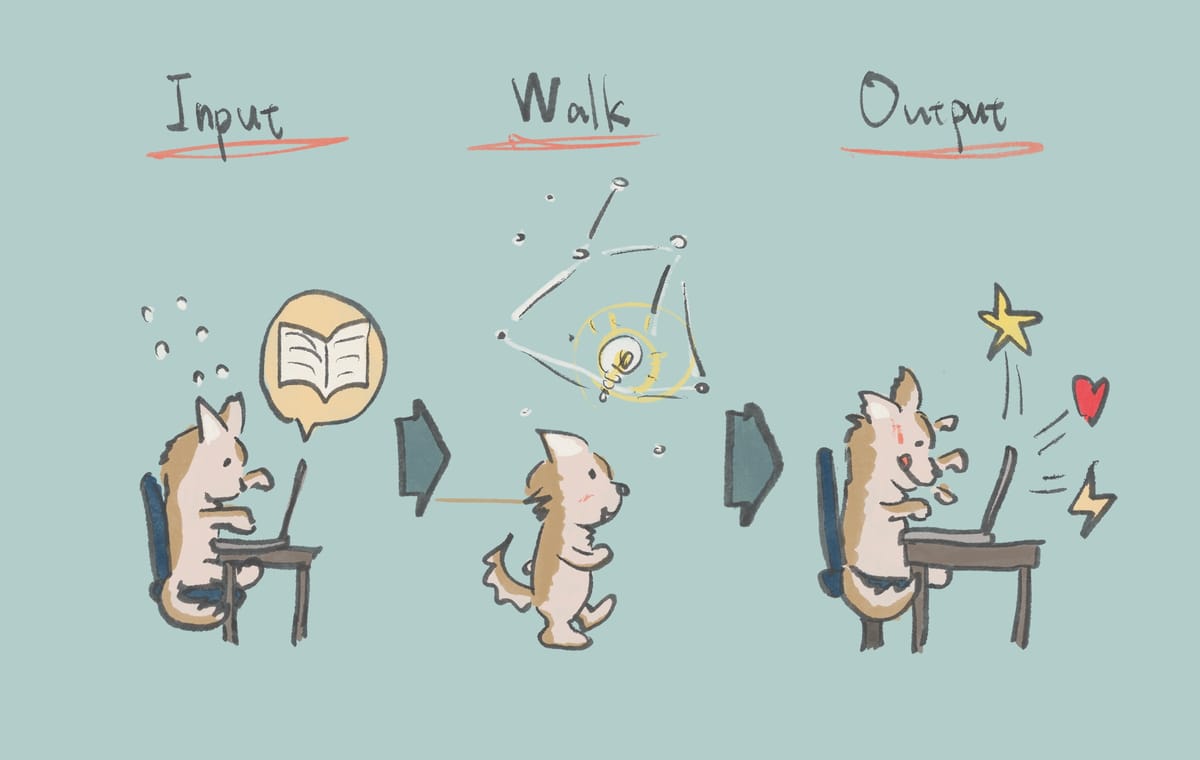
Writing is the act of hammering an anchor (or a hook) into your brain, signaling that "this is important information." Once you’ve written it down, you can eject it from your mind and forget it. I repeat these steps daily:
- Scribble (Carve it into the brain)
- Forget (Free up working memory)
- Relax (Leave it to the subconscious)
By storing information and then letting go, your subconscious mind begins to process it in the background. Instead of overthinking and grunting at your desk, try to keep your conscious mind as empty as possible. This makes it easier for ideas to come to you. When an idea comes, scribble it down, free the memory, and wait again.
[!TIP]
While I used YouTube as an example here, I’ve explained my specific technical note-taking workflow in detail here:
https://www.inkdrop.app/note-taking-tips/
What I’m trying to say is, trust your brain more.
Walk!
Perhaps the most important part is Step 3: letting the subconscious handle the organic connection of ideas while you relax. So, what should you actually do? The answer is simple: Walk.

I mean, step away from the computer. Take a walk. Take a shower. Play an instrument. Immerse yourself in a hobby. Anything that helps you relax. Background processing in the brain is most active when you are in a relaxed state.
When I first started developing Inkdrop, I lived near Hikarigaoka Park in Tokyo.
I must have walked hundreds of laps around that park. I have so many unforgettable memories: the early morning sun filtering through the trees, the fields of swaying cosmos flowers, and even being questioned by a security guard while wandering around late at night.
I also highly recommend carrying a camera. A camera is a perfect device to force your consciousness out of your internal loops and back into the real world. You look at a subject and think, "Wow, what a beautiful light through the leaves." In that moment of external focus, an idea often strikes: "Oh, wait — what if I tried that for that feature?"
This is the idea generation technique I’ve practiced as an app creator, and it’s exactly why I believe a note-taking app should remain simple.
Thanks for reading. Inkdrop is a Markdown-focused note-taking app for developers. It’s not about having tons of features — its strengths are the clean design and simplicity. If you’re looking for a clean and simple notes app, check it out: